

News & Events
Demystifying Academia: On Fellowships with Prof. Marisa Fuentes

Women's & Gender Studies Graduate Program Presents:
Demystifying Academia Graduate Student WorkshopOn Fellowships
with Professor Marisa Fuentes
Wednesday, January 28, 2015
11am - 1 p.m. - Ruth Dill Johnson Crockett Building - Douglass Campus
In an increasingly competitive academic environment graduate students (and junior professors) find the need to supplement and cover many of their research expenses to complete their required publications. Obtaining fellowships outside one’s institution affords us valuable time to complete research and writing without additional teaching and grading responsibilities. Beyond time, winning fellowships builds the CV for other fellowship and award competitions as well as making applicants more competitive in the job market—having demonstrated the ability to acquire outside funding and national recognition for your project. Finally, fellowships supply the resources for international field research that is vital to many of our interdisciplinary projects. This workshop will cover the mechanics (how to identify major grants, the structure of applications and research statements, etc) of applying for funding through national foundations (Ford, Fulbright, AAUW, Woodrow Wilson etc) for the upcoming and subsequent academic years. I will identify the major national fellowships for graduate students in various stages of their careers while going into particular detail with the Ford Foundation fellowships and the Fulbright IEE which are open to various disciplines and not restricted to the humanities. I will also discuss the significance and varieties of postdoctoral fellowships available to graduating students. By the end of this workshop you will have a sense of the major fellowships in your field and a solid understanding of the elements required for a competitive application.
Please RSVP to Suzy Kiefer (
This email address is being protected from spambots. You need JavaScript enabled to view it. )
Human Futures Graduate Student Conference
Department of Women's and Gender Studies, 162 Ryders Lane, Ruth Dill Johnson Crockett Building, Douglass Campus
- Opening Remarks by Dr. Jasbir Puar (Women's and Gender Studies, Rutgers) at 9:30am
- Keynote Address by Dr. Alexander Weheliye (African American Studies, Northwestern) at 11:30am.
- Panel 1 (9:45am): Revolutionary Humanism: Beyond Man, Towards the Human
- Panel 2 (2:00pm): Zoopolitics and Biopolitics: Hum/Animal Futures
- Panel 3 (3:45pm): Species and Cyborgs: Digital Futures, Embodied Futures
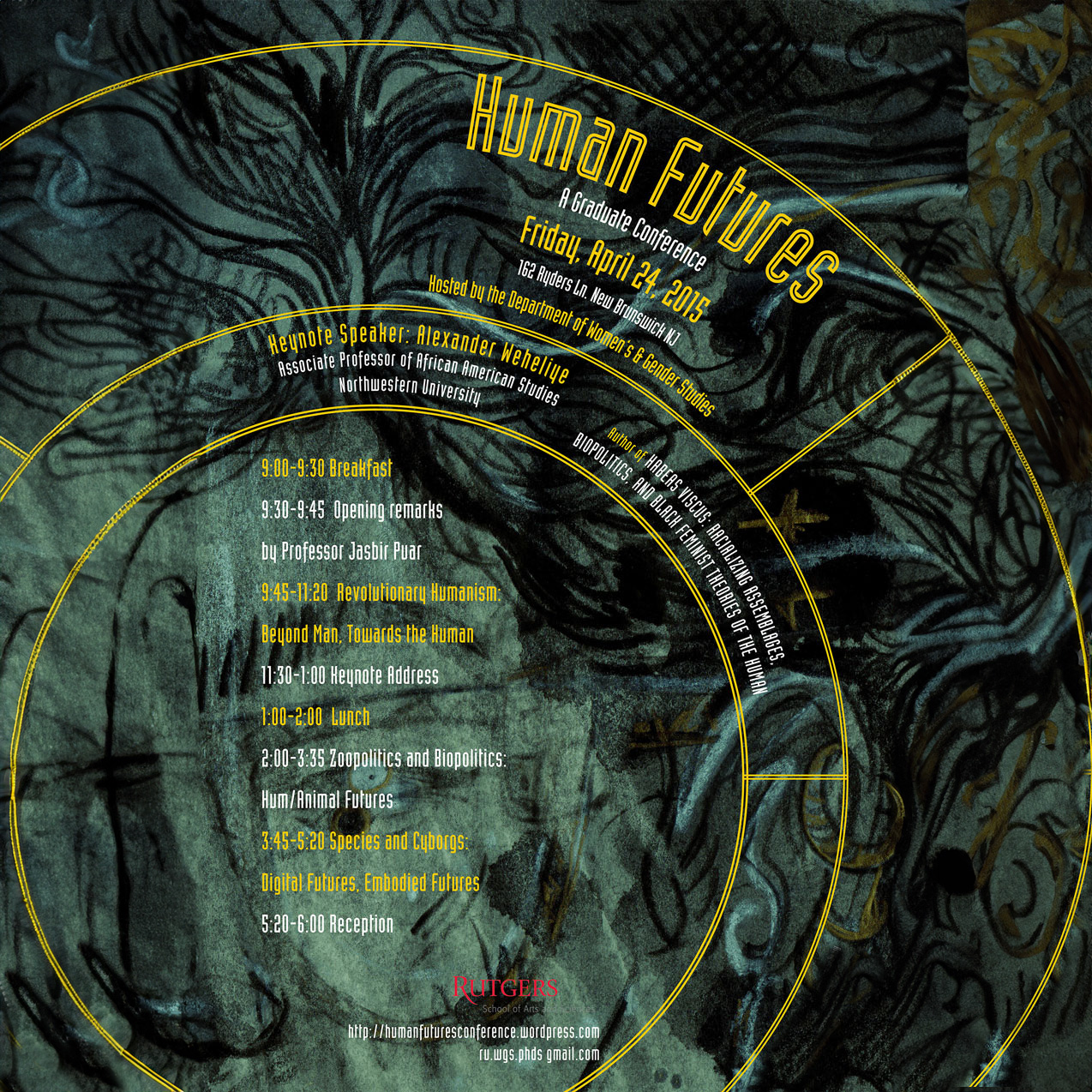
Conference Agenda & Information
Friday, April 24, 2015
8:45 Breakfast and Registration
Hosted by the Department of Women’s & Gender Studies
Rutgers University–New BrunswickKeynote Speaker: Alexander Weheliye
Associate Professor of African American Studies
Northwestern University9:00–9:30 Breakfast
9:30–9:45 Opening remarks
9:45–10:30 Revolutionary Humanism
by Professor Jaspir Puar
Beyond Man, Towards the Human
11:30–1:00 Keynote Address
1:00–2:00 Lunch
2:00–3:35 Zoopolitics and Biopolitics:
Human/Animal Futures
3:45–5:20 Species and Cyborgs:
Digital Futures, Embodied Futures
5:20–6:00 ReceptionRutgers
The State University of New Jersey
CFP: Human Futures Graduate Student Conference

The Department of Women’s and Gender Studies at Rutgers University Presents:
Human Futures
Friday, April 24, 2015
Rutgers – New BrunswickKeynote Speaker: Alexander Weheliye
Associate Professor of African American Studies
Northwestern University
Author of Habeas Viscus: Racializing Assemblages, Biopolitics, and Black Feminist Theories of the Human
Duke University Press, 2014humanfuturesconference.wordpress.com
Proposals Due: January 5, 2015 at
This email address is being protected from spambots. You need JavaScript enabled to view it. In confronting futurity within global conditions of increasing economic stratification and distress, the social and the political are traditionally viewed through an anthropocentric lens that takes human agency and voice as its central determinants. In this context, emergent work in posthumanism, sciences studies, disability studies, animal studies, “new” materialisms, and affect theory seeks to de-exceptionalize human experience as the dominant force that impels global change by challenging conventional understandings of what constitutes agency and the political in relation to more-than-human entities.
At the same time, fields including critical race studies, queer of color critique, decolonial and postcolonial studies, trans studies, disability studies, and feminist critique raise questions regarding the privileged parameters of some of these other-than-human approaches; many argue
for re-centering analyses of the axes of race, gender, sexuality and ability in discussions of politics and the future, given that multiple marginalized and underrepresented peoples have yet to acquire “human” status in the framework of European Humanism and Western Modernity.What does it mean to turn to the other-than-human precisely when the human is being made extinct along lines of gender, race, class and location by capitalism and coloniality?
We invite graduate students from all departments and fields to take a convivial approach to these debates:
- How might we reflect on the impact of more-than-human biological and earthly forces on subjectivity, sexuality, ability and race?
- Can we theorize through a non-anthropocentric vision of ecology, politics, and the social while keeping in mind the axes of differentiation that subjectivize the human today?
- What futures can we collectively imagine that both de-center the liberal Human subject and provide ways of understanding human experience beyond the violent confines of Western Modernity?
- What subjugated knowledges and practices already view the world and the future through a non-anthropocentric lens?
- How are the humanities and the social sciences particularly equipped to mediate the oppositional approaches to the human, futurity, posthumanism(s), and antifuturity?
- How can different ways of knowing –other academic disciplines, spiritual practices, collective knowledges– bring new insights to these questions?
We welcome papers that broadly relate to these issues. We also invite you to interpret these themes loosely, offer alternative frames for the discourse, or critique them.
Artist Presentation: Brief 15 to 20-minute presentations will be made available to artists, poets, performers, and curators who wish to present original work related to the conference topic.
Submissions will be evaluated by standard conference review process; a group of graduate students not presenting at the conference will make decisions regarding proposals and panels. We are dedicated to demystifying this process by attempting to make it as transparent as possible. If you have any questions before or after submitting a proposal, please contact us at
This email address is being protected from spambots. You need JavaScript enabled to view it. .We welcome you to join us in these conversations, and we look forward to your contributions!
November Convivial Conversations: Garbage, Disruption, and the City

Women's & Gender Studies Graduate Program Presents:
Convivial Conversations SeriesMonday, November 24, 2014
11am - 1 p.m. - Ruth Dill Johnson Crockett Building - Douglass Campus
A conversation between Snezana Otasevic, PhD Candidate, and Professor Ethel Brooks
Light refreshments served. Please RSVP to Suzy Kiefer (
This email address is being protected from spambots. You need JavaScript enabled to view it. )Across Europe, Roma occupy a very specific positionality, marked by racism, multiple forms of violence and excessive marginalization. Very often, informal waste recycling (scavenging) is one of the few sources of income and survival for Roma in European urban spaces. A large number of Roma are denied citizenship rights and basic legal documents such as birth certificates and residency cards, even though they have lived in the same territory for generations; in the current moment, Roma throughout Europe are facing forced evictions, expulsions, increased violence and segregation --with walls being built around a number of Romani communities or the communities themselves being evicted from decades- or centuries-old neighborhoods and moved to sites outside of the city, and residents denied access to education, health and employment.
In this paper, we will examine the relationship between Roma, waste, and sovereignty. We explore the modes of disruption available to and associated with Romani subjectivity through a focus on informal waste recycling and the advent of formal recycling programs in Belgrade, which has taken place alongside large-scale evictions of Belgrade's Romani residents and struggles over urban space. What can struggles over productive practices, real estate and Romani belonging tell us about the formation of the city, its relation to garbage and the politics of disruption?
Gender & Media Minor - Spring 2015

RUTGERS University
School of Communication and Information and Department of Women’s and Gender Studies present a BRAND NEW cross-unit interdisciplinary course of study for students interested in both gender and media:
The Minor in Gender and Media
- Enroll in 18 credits in courses from Women’s and Gender Studies and the School of Communication and Information
- Take courses in critical media/feminist theory and media production
- Analyze gendered power dynamics in the media
- Examine, create, and improve current conditions in the media
- Acquire hands-on, technical skills as a media producer
- Produce a multi-media capstone project
- Explore exciting internship opportunities
The Minor in Gender and Media can be declared as of Spring 2015.
For information or to begin taking applicable courses, contact
Dr. Yana Rodgers, Undergraduate Director of Women’s and Gender Studies, atThis email address is being protected from spambots. You need JavaScript enabled to view it. , or
Dr. Mary Chayko, Director of Undergraduate Interdisciplinary Studies at the School of Communication and Information, atThis email address is being protected from spambots. You need JavaScript enabled to view it. .WOMEN,
MEDIA & TECH
An IMJ Consortium and SC&I Initiative
Conference Feminist Digital Pedagogies (January 23-24)

Feminist Digital Pedagogies
Conference Schedule
Thursday, January 23, Alexander Library Teleconference Lecture Hall, 4th floor
1:00 – 2:30 Crowdsourcing the Best Digital Humanities Scholarship: Experimenting with #DHThis -- Adeline Koh
2:45 – 3:30 Engaging Students across the Disciplines in Feminist Dialogues on Technology: Lessons, Challenges, Successes -- Karen Alexander, Katherine Li, Megan McCarron-Haber, Elaine Zundl
3:45 – 5:15 ReImagining the Promise of Network Learning: A Report on FemTechNet's DOCC on Feminism and Technology -- Anne Balsamo and Alex Juhasz
5:15 – 6:00 Reception
Friday, January 24, Ruth Dill Johnson Crockett Building, First Floor Conference Room
8:30 Continental Breakfast
9:00 – 10:00 Activist Learning in the Digital Classroom:
Feminist Coalitions in Unlikely Places: Movement-Building Capacities of the Online Classroom -- Kelly Coogan-Gehr
Rethinking Pedagogy and Power in the Disembodied Classroom -- Chrisy Moutsatsos
Beyond the Logic of Division: The Online Classroom as a Locus of Inter-generational Interdependence -- Heidi Hoechst
10:00 – 11:00 Flipd with Sesh Venugopal
11:15 – 1:15 The Rewriting Wikipedia Project -- Adeline Koh
1:15 – 2:00 Box lunch
2:00 – 4:00 Percussive Pedagogies: Teaching (And Being Taught) Feminism in Digital Spaces
Crunk Feminist Collective: Robin Boylorn, Brittney Cooper, Sheri Davis-Faulkner, Susana M. Morris, Eesha Pandit
For a free box lunch on Friday, please rsvp to Susana Galan,
This email address is being protected from spambots. You need JavaScript enabled to view it. by Jan 17.
On Thursday, visitors to campus may park in Lots 26, 30 & College Avenue Deck without permits.On Friday, visitors may use Lots 74A & Douglass Deck without permits.
Participant Bios
Karen Alexander is Dean of Junior and Senior Year Programs at Douglass Residential College. Her PhD from the University of London is in contemporary American writing. Formerly Senior Editor at Signs: Journal of Women in Culture and Society, she co-founded the online publication Films for the Feminist Classroom. Her research interests include feminist art and media and the role of technology in the changing landscape of academic publishing and scholarship.
Anne Balsamo is Professor and Dean of the School of Media Studies at the New School for Public Engagement in New York City. A groundbreaking national leader in media studies, a scholar and media-maker whose work links cultural studies, digital humanities, and interactive media, Dr. Balsamo received her PhD in Communications Research from the University of Illinois at Urbana-Champaign and began her faculty career in the School of Literature, Culture, and Communications at Georgia Tech, where she published a distinguished book about the cultural implications of emergent biotechnologies, Technologies of the Gendered Body: Reading Cyborg Women. In 1999, having grown interested in the practical linkages between technology and culture, she accepted an offer to join the celebrated Xerox Palo Alto Research Center (PARC), collaborating in the design of media for reading, exhibition, public art, and cultural projects. In 2003, Dr. Balsamo moved from Silicon Valley to USC, where she had been jointly appointed in the Annenberg School of Communications and the School of Cinematic Arts. She directed the Collaborative Design Lab within the Interactive Design Division of the School of Cinematic Arts. She has been a leader in the growth of digital humanities nationally, serving on the Advisory Board of HASTAC (Humanities, Arts, Science, and Technology Advanced Co-laboratory) since its founding in 2003. In 2011, she published Designing Culture: The Technological Imagination at Work, a transmedia book (with accompanying DVD and web linkages to interactive media projects) that synthesizes and theorizes the links between her cultural studies scholarship and digital media projects.
Robin M. Boylorn is Assistant Professor of Interpersonal and Intercultural Communication at The University of Alabama. Her first book Sweetwater: Black Women and Narratives of Resilience (Peter Lang, 2013) received the inaugural Bud Goodall & Nick Trujillo "It's A Way of Life" Award for Excellence in Narrative Ethnography and the 2013 Book of the Year Award by the Ethnography Division of the National Communication Association. She is co-editor of Critical Autoethnography: Intersecting Cultural Identities in Everyday Life (Left Coast Press, 2014). Her work focuses on issues of diversity and social identity, and the intersections of race, class, and gender/sex. Her work offers social and cultural critiques of representations of black women utilizing her personal lived experiences and creative and performative writing.
Kelly Coogan-Gehr is an Educator for the Institute for Health and Socio-Economic Policy of the National Nurses United. She received her B.A. in Women’s Studies from Duke University and her PhD in Women’s and Gender Studies from Rutgers University. Her scholarly publications complicate existing histories of academic feminism and women’s studies by developing alternative accounts of feminist field formation. For her scholarship, Coogan-Gehr was named an Exemplary Diversity Scholar by the National Center for Institutional Diversity. She currently teaches continuing education classes for nurses on the relationship among the environment, health, and the economy and on the relationship between nursing and the global economy. She has taught feminist pedagogies, feminist theories and methodologies, and critical race feminisms at Rutgers University and Eastern Washington University where she was awarded the Jeffers Chertok Dean’s Faculty Award for Outstanding Teaching and Mentorship two years in a row.
Brittney C. Cooper is co-founder of the Crunk Feminist Collective. She received her Ph.D. from Emory in 2009 and spends her days as Assistant Professor of Women’s and Gender Studies and Africana Studies at Rutgers University where she specializes in Black Feminist Thought, Black Women’s Intellectual History, Hip Hop Studies, and Digital Feminisms. Crunktastic is most well-known for calling folks on their racist and sexist B.S. in her impassioned posts about gender politics in and among the Hip Hop Generation, convergences of faith and feminism, dating while feminist, and contemporary feminist movements. She recently completed her first book, Race Women: Gender and the Making of a Black Public Intellectual Tradition. Dr. Cooper is a weekly contributor at Salon.com and was also named to The Root 100 for 2013, an annual list of Top Black Influencers featured at TheRoot.com. Follow her on Twitter @ProfessorCrunk.
Sheri Davis-Faulkner is an interdisciplinary scholar working in College of the Liberal Arts at Georgia Institute of Technology to develop University-community partnerships in West Atlanta. Davis-Faulkner received her PhD in 2012 from the Graduate Institute of the Liberal Arts at Emory University. An Atlanta native, she currently works across higher education institutions in Atlanta to advance coordinated engagement and accountability that enhances the educational landscape of youth and students in adjacent communities. In addition to teaching a Poverty and Social Justice course at Spelman College, she has also taught Women’s Studies, American Studies, and Visual Culture courses at Clark Atlanta University and Emory University. Beyond the academy Davis-Faulkner works with environmentalists and direct service health organizations to engage college students and local youth in community building as agents of change. Her research interests are feminist media studies, corporate body politics, food and environmental literacy as public health interventions, black feminist literature for social justice, labor rights, and digital literacy. Sheri is passionately committed to partnership with Treston Davis-Faulkner, her crunk feminist husband, and parenting Na’im Faulkner, her fire+Leo six-year-old son. She spends her time planning school events with the Parent Teacher Student Association as well as playing basketball and chess, hiking at our Nature Trail, baking sweet potato waffles, watching Wild Kratz and wild animal nature shows, being on picket lines, and practicing capoeira with her boys.
Heidi Hoechst is an Educator at the Institute for Health and Socio-Economic Policy of the National Nurses United. Hoechst received a B.A. in Women’s Studies and English from the University of Minnesota, Morris, an M.A. in Literatures in English and Ph.D. in U.S. Cultural Studies from the University of California, San Diego. Her research has focused on the cumulative racializing impacts of speculative bubbles and panics from 19th century indigenous land and slave markets through the 21st century housing crisis. Hoechst has taught in Women’s, Gender, Feminist, Sexuality, Critical Race, Critical Legal, Cultural, and American Studies as well as English and Literature for National Nurses United; Tulane University; the University of California, Santa Barbara; Cornell University; Auburn State Correctional Facility; the University of California, Santa Cruz, and the University of California, San Diego. She has been recognized as an Outstanding Faculty member, Exemplary National Diversity Scholar, and Andrew W. Mellon Postdoctoral Fellow. Her soul as an activist intellectual has been sustained by the creativity and critical thinking of students, activists and workers who collaborate in her classes from widely diverse backgrounds, locations and learning experiences to challenge systemic inequality and injustice.
Alexandra Juhasz is Professor of Media Studies at Pitzer College in California. She has a Ph.D. in Cinema Studies from NYU and has taught courses at NYU, Swarthmore College, Bryn Mawr College, Claremont Graduate University, and Pitzer College, on YouTube, media archives, activist media, documentary, and feminist film. Dr. Juhasz has written multiple articles on feminist, fake, and AIDS documentary. Her current work is on online feminist pedagogy, YouTube, and other more radical uses of digital media. Dr. Juhasz produced the feature films, The Owls, and The Watermelon Woman, as well as nearly fifteen educational documentaries on feminist issues like teenage sexuality, AIDS, and sex education. Her first book, AIDS TV: Identity, Community and Alternative Video (Duke University Press, 1996) is about the contributions of low-end video production to political organizing and individual and community growth. Her second book comprises transcribed interviews from her documentary about feminist film history, Women of Vision, with accompanying introductions (Minnesota University Press). Her third book, F is for Phony: Fake Documentary and Truth’s Undoing, was co-edited with Jesse Lerner, from the University of Minnesota Press. Dr. Juhasz's innovative "video-book," Learning from YouTube (2011), is recently published by the MIT Press. Her earlier digital effort is Media Praxis: A Radical Web-Site Integrating Theory, Practice and Politics. She blogs on this and other projects at www.aljean.wordpress.com.
Adeline Koh is Director of DH@Stockton and assistant professor of literature at Richard Stockton College. Her work spans the intersections between postcolonial studies and the digital humanities, 19th/20th Century British and Anglophone Literature and Southeast Asian and African studies, and games in higher education. Koh directs Digitizing 'Chinese Englishmen,' a digital archival project on 19th century 'Asian Victorians' in Southeast Asia, and The Stockton Postcolonial Studies Project, an online magazine of postcolonial studies. She is the designer of Trading Races, an elaborate historical role playing game designed to teach race consciousness in the undergraduate classroom, and runs the postcolonial digital humanities website and tumblr blog with Roopika Risam. She is also a core contributor to the Profhacker Column at the Chronicle of Higher Education. She has held a Duke University Humanities Writ Large Fellowship and a postdoctoral fellowship at the National University of Singapore.
Katherine Li is a senior at Douglass College, Rutgers Univesity double majoring in Visual Art and Information Technology and Informatics. She is an avid participant in Douglass Residential College’s inaugural DOCC on Race, Gender, and Technology.
Megan McCarron-Haber is a junior at Douglass College, Rutgers University majoring in Women’s and Gender Studies and minoring in International and Global Studies. She is an avid participant in Douglass Residential College’s inaugural DOCC on Race, Gender, and Technology.
Chrisy Moutsatsos is an Educator for the Institute for Health and Socio-Economic Policy of the National Nurses United. She earned her Ph.D. at the University of California, Irvine, in Social Science with an emphasis in Women’s Studies in 2001. Her dissertation, Transnational Beauty Culture and Local Bodies: An Ethnographic Account of Consumption and Identity in Urban Greece, received the John O. Iatrides Best Dissertation Award by the Modern Greek Studies Association, in 2003, and in 2001 she was a Visiting Research Fellow at the Seeger Center for Hellenic Studies at Princeton University. Her publications offer a critical examination of the ways in which neoliberal globalization shapes gendered subjectivity in the context of print advertisements, direct marketing, and consumption in the U.S. and the European Union. Her broader research interests include women’s health and the relationships among gender, labor, health, and globalization. She has over twenty years of experience teaching courses in gender and sexuality studies, anthropology, sociology, and cultural studies at small and large teaching institutions, such as UC Irvine, Scripps College, and Iowa State University.
Susana M. Morris is co-founder of the CFC and a contributing writer on the blog. She received her Ph.D. from Emory University and is currently an associate professor of English at Auburn University, where she teaches African American literature. Her book project, Close Kin and Distant Relatives: The Paradox of Respectability in Black Women’s Literature, is forthcoming on the University of Virginia Press in February 2014. Writing as Crunkadelic on the CFC blog, she covers a range of topics such as politics, self-care, sizeism, and reality TV, often irreverently. Her iPod has a mix of all types of soul music, with a smattering of Dolly Parton and Florida booty music, and her DVR is filled with episodes of Parks and Rec and the Real Housewives of Atlanta. Follow her on Twitter @iamcrunkadelic, where she shares random thoughts, feminist musings, and obnoxiously live tweets during Scandal.
Eesha Pandit is a writer and activist who believes in social justice movements, the power of intersectionality, feminism, sisterhood and the power of art. Her writing can be found here at The Crunk Feminist Collective, The Nation, Feministing, Salon, RH Reality Check, Feministe and In These Times. She has also appeared on numerous TV news outlets including CNN, HLN, MSNBC and Grit TV with Laura Flanders. She most recently worked as Executive Director of Men Stopping Violence, a social change organization dedicated to ending men’s violence against women. She’s also served as as Women’s Rights Manager at Breakthrough, a global human rights organization. At Breakthrough Eesha worked on the Bell Bajao! (Ring the Bell!) Campaign that asks men and boys to take action, get involved and help end violence against women. Previously, Eesha served as Director of Advocacy at Raising Women’s Voices (RWV). RWV is a national initiative working to make sure women’s voices are heard and women’s concerns are addressed as policymakers put the new health reform law into action. Eesha has also served as Associate Director of Programs at the Civil Liberties and Public Policy Program at Hampshire College where she coordinated the organization’s New Leadership Networking Initiative and the Reproductive Rights Activist Service Corps. She’s worked with the Carr Center for Human Rights Policy at Harvard University, and Amnesty International USA’s Women’s Rights Program. Eesha currently serves on the board of the National Network of Abortion Funds. She has a B.A. from Mount Holyoke College and an M.A. from the University of Chicago. You can follow her on Twitter at @EeshaP.
Sesh Venugopal is Director of Introductory Undergraduate Education in the Computer Science Department at Rutgers, The State University of New Jersey. He earned his Ph.D. in Computer Science at Rutgers and his Bachelor of Technology in Computer Science and Engineering at the Indian Institute of Technology in Mumbai. His doctoral research focused on Supercomputing: developing scalable algorithms for sparse matrix computations. Dr. Venugopal is the founding director of the Computer Science Industrial Affiliates Program (IAP), and the principal liaison for industry relationships. He is also the faculty advisor to the student clubs USACS and RuMAD, and is on the faculty of Rutgers Advanced Technology Extension (RATE). In 2010, he received the School of Arts and Sciences Award for Distinguished Contributions to Undergraduate Education.
Elaine Zundl is the Dean of the Douglass Project for Rutgers Women in Math, Science and Engineering at Douglass Residential College. Currently, she develops programs to recruit and retain women and minorities in science, technology and engineering fields where they remain underrepresented. Her main interest is in integrating gender into research content and methods as a way to improve outcomes and lead to greater diversity in STEM.
Undergraduate Grants to participate in the 12th International Interdisciplinary Congress on Women in Hyderabad, India

Interested in Transnational Feminist Activism?
Curious about what goes on at international meetings of feminist activists and scholars?
Excited about participating in the 12th International Interdisciplinary Congress on Women,
Women’s Worlds in Hyderabad, India, August 17-21, 2014?
Then we have the opportunity for you…
The Department of Women’s and Gender Studies has funding to support the participation of 4 to 5 undergraduate students in the 2014 International Interdisciplinary Congress on Women in Hyderabad. The general theme of the Congress is “Gender in a Changing World.” The conference will attract thousands of feminist activists from all parts of the world, presenting workshops on Gender & Culture, Gender & Work, Gender & Health, Gender & Information Technology, Gender & Science and Technology, Gender, Globalization, Politics and Policy, Gender & Management, Gender & Law, Gender & Violence, Women’s Empowerment, and Minority Women’s Issues.
Funding will cover transportation, conference registration, lodging and food.
Participation in this exciting opportunity includes multiple components:
- Students will enroll in WGS 988:494, Independent Study in Spring 2014
- Working with faculty advisors, students will develop papers to be presented at an Interdisciplinary Forum at Rutgers University and again at Women’s Worlds Conference in Hyderabad (http://womensworld2014india.com/ws/)
- While in Hyderabad, students will participate in the cultural program, social program, and tourist program associated with the Conference.
To be considered for funding, students should submit a resumé and statement of interest by December 6, 2013 to Women’s Worlds Conference Committee, Department of Women’s and Gender Studies. Statements of interest should include the following information:
- Record of involvement in social justice activism;
- Leadership experience at home or abroad;
- Discussion of the benefit that conference participation will provide for your future feminist activism or leadership objectives.
Successful applicants will be informed by December 20, 2013.
Funding for this program has been made possible by the generous support of the Institute for Women’s Leadership, the Department of Women’s and Gender Studies, and the School of Arts and Sciences Honors Program.
Fall Classes in the Certificate Program in Women's Global Health Leadership

As part of the Certificate Program in Women’s Global Health Leadership, we are pleased to announce the Fall 2014 courses Global Women’s Health Movements, The Growth Imperative, Global Ecology, and Women’s Health, and Debt, Crisis, and Women’s Health. Each course is offered entirely online.
Class Descriptions:
Women’s Global Health Movements (01:988:407)
Professor Julia Wartenburg
ONLINEInformed by the history of the International Women and Health Meetings (IWHMs), this course investigates the political vision and organizational structure for women’s health movements around the world. It contrasts early strategies driven by coalitions of activists from the North, which focused on reproductive rights, self-help, and a definition of health based largely in the physiology of women’s bodies with approaches advanced by activists from the global South, which attend to the social, cultural, and economic factors that affect women’s access to the most basic healthcare. This course examines how and why contemporary feminist conceptions of health are grounded in a comprehensive framework attentive to international power dynamics, globalization, macroeconomic policy, national and global poverty, conflict and war, and debt crises in various countries. Beginning with an overview of women’s contemporary health challenges, the class then analyzes the political tactics and strategies women have devised to secure access to healthcare for themselves, their families, households and communities. Introducing students to the global institutions, organizations, and policies that impact health, course material also traces how women’s nongovernmental organizations have attempted to transform existing institutions and policies of global health governance to enable women in all regions of the world to lead physiologically, psychologically, and emotionally healthier, more dignified lives.
The Growth Imperative, Global Ecology, and Women’s Health (01:988:409)
Professor Julia Wartenburg
ONLINEOver the past half-century, scholars have debated the relationship between the quest for “endless growth”–capital accumulation on a global scale–and resource exhaustion. This course situates women’s health in the context of these debates, investigating the health consequences of environmental crises linked to various market-based development strategies and technological innovations. Analyzing externalized business costs in the currency of human health, the course investigates illness caused by toxic industrial products and byproducts, injury from resource extraction processes such as nuclear fission and deep-water oil drilling, the manifold health hazards stemming from violent conflict over control of scarce resources in postcolonial states, and dangers that attend dislocation resulting from climate change.
Debt, Crisis, and Women’s Health (01:988:410)
Professor Heidi Hoechst
ONLINEGrowing national debt has become a feature of increasing numbers of nations over the past 60 years, heightening dependence on international financial institutions and restricting the sphere of freedom of national policy makers. Health care provision has been subjected to severe cuts as nations struggle to meet their debt obligations and stabilize their economies. Framing ongoing global economic crisis as a consequence of excess rather than scarcity, this course unsettles the conventional moral calculus of credit and debt, exploring the relationship between debt and economic crisis, and examining the impacts of austerity policies on women’s health. Comparing experiences of nations in various regions of the world, the course considers the effects of continued borrowing to pay debt interest on humanitarian concerns. In particular, the course analyzes who suffers for the sake of debt repayment and the magnitude of that gendered suffering in highly leveraged societies.
2017-2018
Find out what's new at the Department of Women's and Gender Studies with our newsletter Feminist Trajectories
The latest edition features departmental and faculty highlights, graduate student news, updates from the Alumni, and WGS photo gallery.


